Dry vs. Wet Dog Food: What Owners Need to Know

The Debate That Never Quite Settles
Walk into any pet store and you’ll find two walls facing each other: one stacked with bags of kibble, the other lined with trays and cans of wet food. Ask five dog owners which is “better” and you’ll get five confident, contradictory answers. The honest answer is that dry and wet food aren’t competitors — they’re different tools, and the right one (or combination) depends on what’s happening inside your dog, not just what looks good in the bowl. Every visible sign of health — a shiny coat, clear eyes, steady energy — starts with digestion, hydration, and nutrient absorption long before it shows up on the outside.
What Actually Separates Them
| Dry food (kibble) | Wet food (canned/pouch) | |
|---|---|---|
| Moisture content | ~8–12% | ~70–85% |
| Energy density | Higher per gram; smaller portions needed | Lower per gram; larger portions needed |
| Processing | Extruded under heat and pressure | Canned or retorted, more gently cooked |
| Texture effect | Crunch can help scrape plaque off teeth while chewing | Soft texture is easier on sensitive mouths and aging teeth |
| Shelf life | Months to a year+ unopened | Long unopened; 1–3 days refrigerated once opened |
| Typical protein form | Dried meat meal, often multi-protein | Fresh or minimally processed meat, often single-protein |
Neither column is “healthier” by default — the differences only matter in how they interact with a specific dog’s digestion, hydration needs, and mouth.
Where Dry Food Earns Its Place
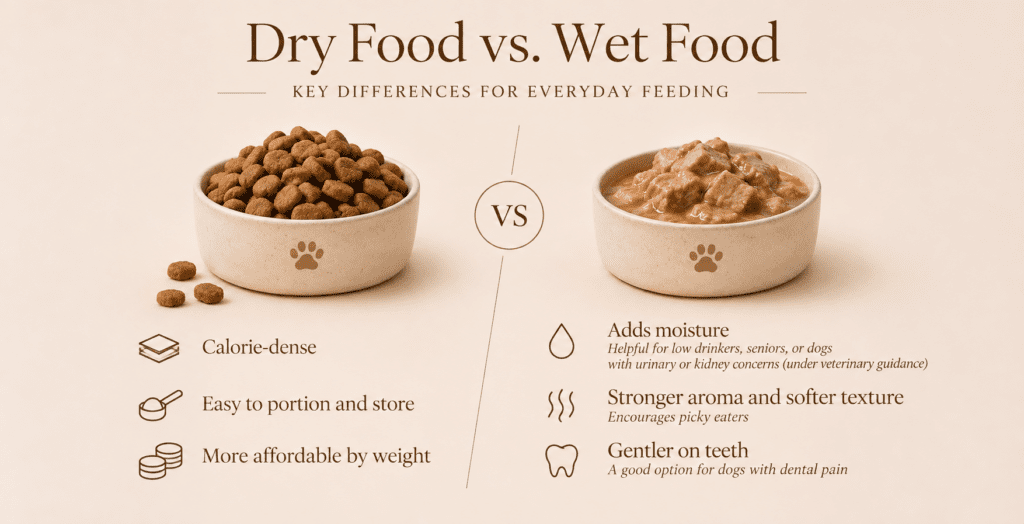
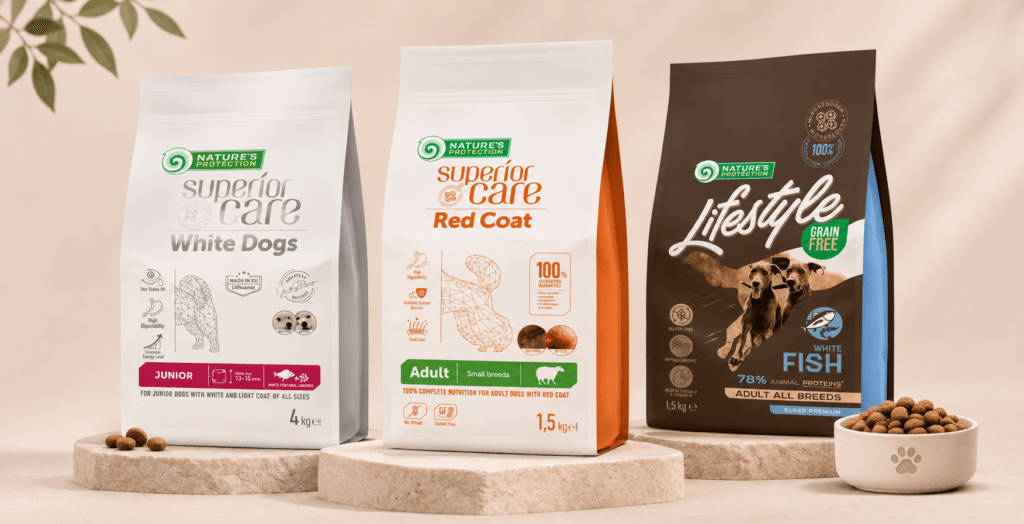
Kibble’s practical strengths are well known: it’s calorie-dense, easy to portion and store, and generally the more affordable way to feed by weight. A few of Nature’s Protection’s dry lines show how kibble can also be built around a specific need rather than just convenience:
- NP Superior Care – dry food with white fish, for growing dogs of all sizes with white coat: aimed at puppies and junior dogs, marketed to help reduce brown tear staining and support healthy skin and coat, with omega-3/6 cited for coat color and the kibble’s crunch noted as a help toward dental health.
- Dry food for adult small breed dogs with lamb: a single main protein (38% dried lamb) sized for small mouths, with marigold blossom included for its anti-inflammatory properties and support for smooth digestion.
- Lifestyle – grain-free dry food for adult dogs of all breeds with white fish: built around white fish as a hypoallergenic, easily digestible protein, with potato and peas replacing grain — a relevant option when an owner suspects a dog doesn’t tolerate grain well.
The common thread: the benefit isn’t the crunch itself — it’s what the formula inside the kibble is built to do.
Where Wet Food Does What Kibble Can’t
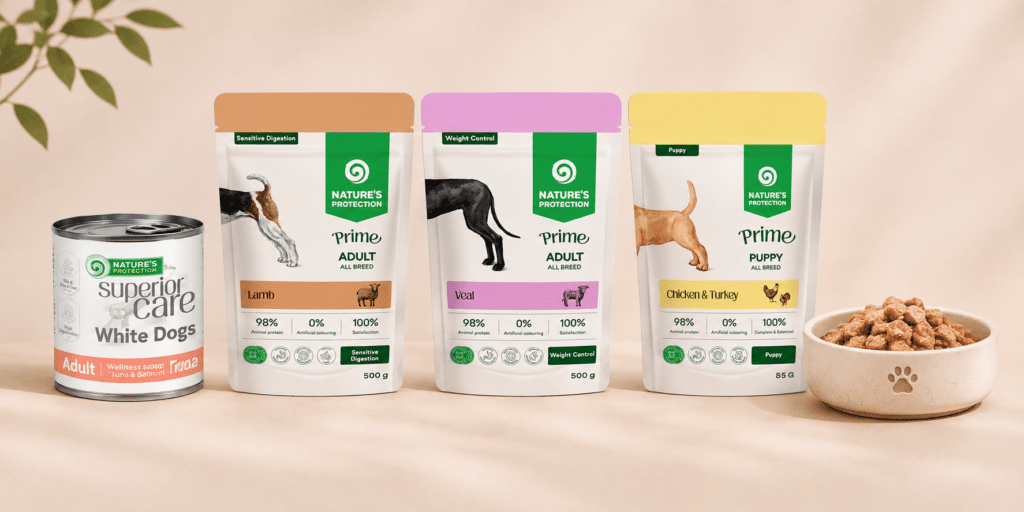
Wet food’s biggest practical advantage is moisture — useful for dogs that don’t drink enough on their own, seniors, or dogs managing urinary or kidney concerns under veterinary guidance. Its stronger aroma and softer texture also help with picky eaters and dogs with dental pain. Nature’s Protection’s Prime wet range shows how a complete wet meal can be built around one specific goal: (Click here)
- NP Prime – chicken and turkey: a complete wet meal for puppies.
- NP Prime – salmon and chicken: for adult dogs, formulated to support skin and coat.
- NP Prime – lamb: a single-protein recipe for adult dogs with sensitive digestion.
- NP Prime – game: for adult dogs, built around joint support.
- NP Prime – veal: for adult dogs, formulated for weight maintenance.
Worth knowing: not everything wet is a full meal. Nature’s Protection’s Superior Care “broths” and tuna wet toppers (for dark-, red- and white-coated dogs) are marketed as complementary — useful for hydration or as a coat-color topper, but not meant to replace a complete diet on their own. Always check a wet product’s label for “complete” versus “complementary” before using it as a dog’s only food.
Choosing One, or Both
There’s rarely a single right answer, but a few questions narrow it down fast:
- Life stage: puppies and growing dogs generally need higher-calorie, nutrient-dense formulas built for growth, not an adult maintenance recipe.
- Breed size and jaw: small-breed dogs often do better on small kibble or soft wet food than on pieces sized for larger breeds.
- Hydration and health conditions: dogs prone to urinary issues, kidney concerns, or that simply don’t drink enough water often benefit from wet food’s moisture — always under a vet’s guidance for any medical condition.
- Dental and digestive sensitivity: dogs with dental pain or sensitive stomachs often do better on soft wet food or softened kibble.
- Budget and routine: dry food travels, stores, and scales to larger dogs more affordably; wet food is often pricier per calorie but can matter for picky or unwell dogs.
Many owners land on mixed feeding — a dry food as the calorie base, with a wet food or topper added for moisture, palatability, or a targeted benefit like skin, coat, or digestion. When switching or mixing foods, transition gradually over 5–7 days to avoid digestive upset.
The Bowl Is Just the Last Step
Whichever format you choose, the real work happens before the food ever reaches the bowl: in how well it’s digested, how it’s absorbed, and how consistently it’s fed. A shiny coat, clean breath, and clear eyes aren’t things you fix from the outside — they’re signals of what’s going on inside. That’s also why the next question worth asking isn’t just “dry or wet,” but what those outward signs — including something as small as tear staining — are actually trying to tell you.
If you’re unsure which approach fits your dog’s age, breed, or health needs, a conversation with your vet or breeder beats guessing every time.